

 Master Thesis Online


Feasibility study of three-dimensional patient-specific simulation of glenohumeral range of motion.

Dirick, Thomas 
Promotor(s) :
Schwartz, Cédric
Date of defense : 30-Jun-2025/1-Jul-2025 • Permalink : http://hdl.handle.net/2268.2/23345
 All files (archive ZIP)
 ThomasDirick_MasterThesis.pdf
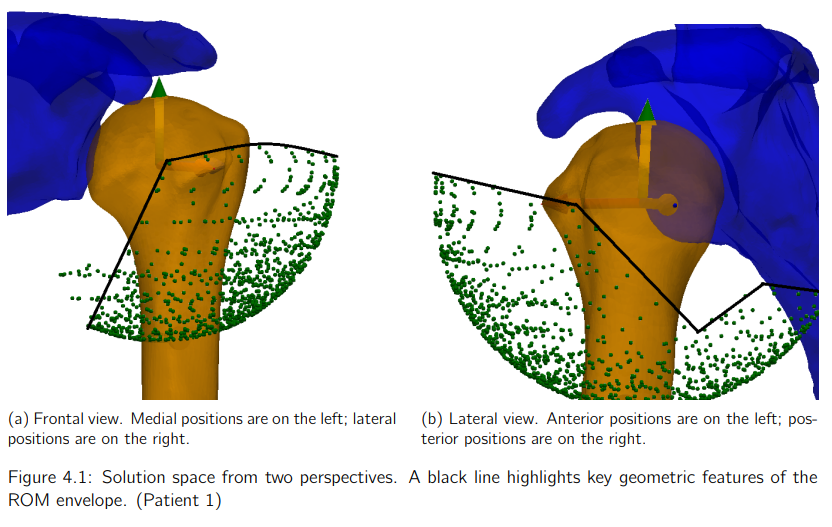 solutionSpace.png
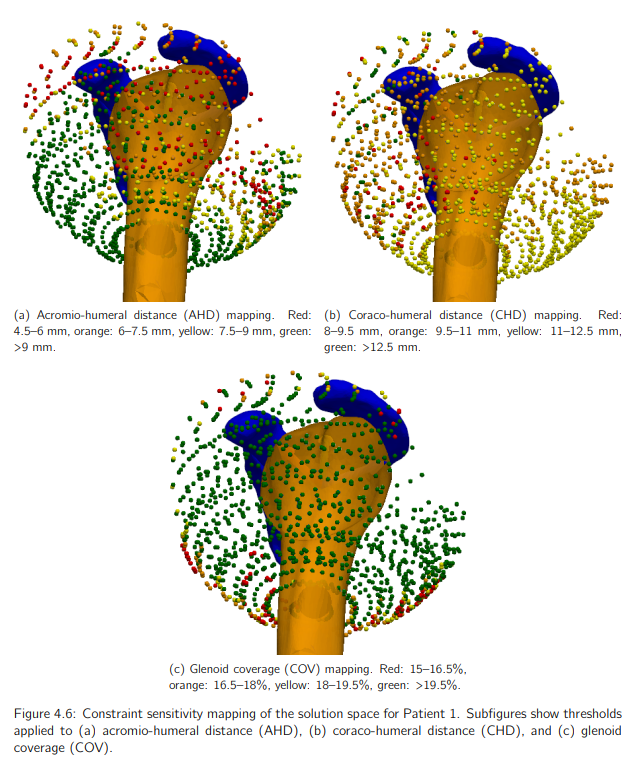 constraintMapping.png
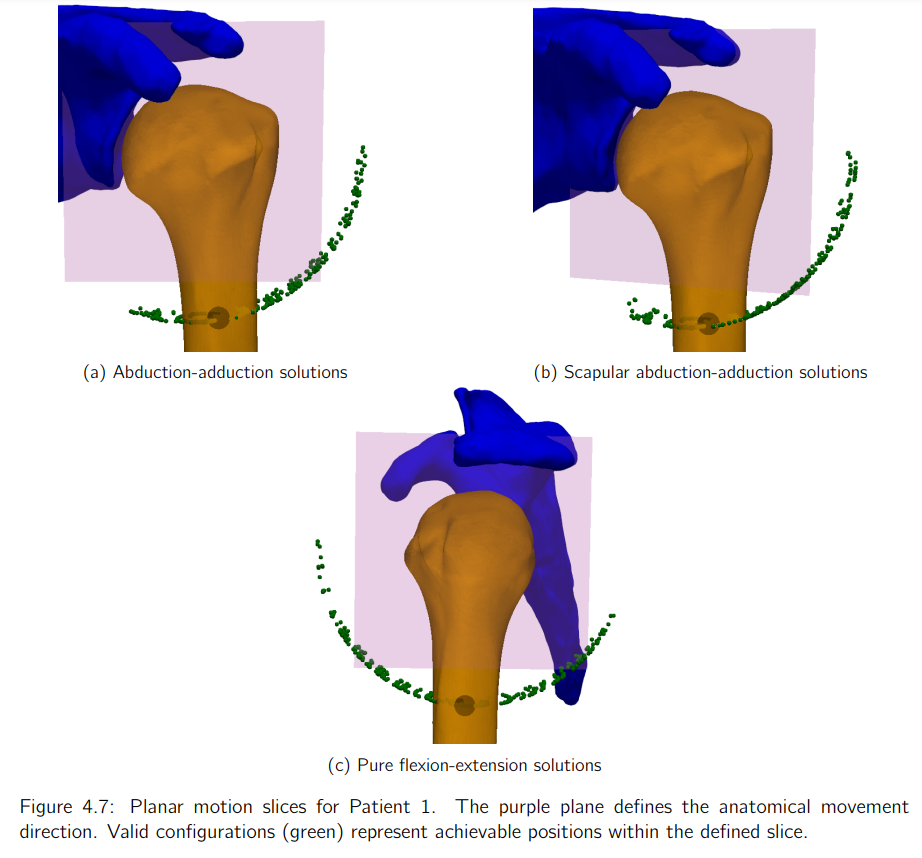 plananMotion.png
Details
| Title : | Feasibility study of three-dimensional patient-specific simulation of glenohumeral range of motion. |
| Translated title : | [fr] Étude de faisabilité d'une simulation 3D spécifique au patient de la portée de mouvement de l'articulation gléno-humérale. |
| Author : | Dirick, Thomas
|
| Date of defense : | 30-Jun-2025/1-Jul-2025 |
| Advisor(s) : | Schwartz, Cédric
|
| Committee's member(s) : | Bruls, Olivier
Ruffoni, Davide
Meynen, Alexander |
| Language : | English |
| Number of pages : | 66 |
| Keywords : | [en] Glenohumeral Joint [en] Range of motion [en] Shoulder instability [en] Patient-specific modeling [en] Anatomical constraints [en] Feasibility study [en] Orthopaedic biomechanics |
| Discipline(s) : | Engineering, computing & technology > Mechanical engineering Human health sciences > Orthopedics, rehabilitation & sports medicine |
| Institution(s) : | Université de Liège, Liège, Belgique |
| Degree: | Master en ingénieur civil biomédical, à finalité spécialisée |
| Faculty: | Master thesis of the Faculté des Sciences appliquées |
Abstract
[en] Shoulder instability is a common clinical problem, especially in patients with bone defects like Hill-Sachs or bony Bankart lesions. Today, most preoperative tools are made for shoulder replacements and do not help evaluate joint stability in patients who need bone-preserving surgeries. This thesis aims to fill that gap by developing a patient-specific simulation tool that estimates the range of motion (ROM) of the glenohumeral joint using 3D computed tomography (CT) scans of the scapula and humerus.
The main goal is to identify which joint configurations are stable and which are not, using a set of anatomical constraints. The simulation works in two steps: first, it samples possible positions in a wide area, and then it uses a binary search to refine the boundaries of the valid space. Several constraints are used to evaluate each position, including bone collision, glenoid coverage, distances between bones, and tuberosity orientation.
The method was tested on five different patients. Results showed that bone defects, especially glenoid bone loss, reduced the amount of valid movement. Among the constraints, glenoid coverage was the most common reason for rejecting a joint position, followed by acromiohumeral and coracohumeral distances. Finally, a clinical application is presented to evaluate whether Hill-Sachs lesions engage within the computed range of motion. The results indicate that the risk of engagement depends more on the location of the defect than on its size. Notably, some engagements were observed even in near-neutral arm positions, not only at the boundaries of the ROM.
In conclusion, this feasibility study presents an approach for simulating glenohumeral motion using patient-specific CT data. While the tool provides an initial framework for exploring joint stability, its current limitations prevent clinical application. Further work is required to determine whether these limitations can be overcome in future developments.
File(s)
Document(s)

Annexe(s)

Cite this master thesis
The University of Liège does not guarantee the scientific quality of these students' works or the accuracy of all the information they contain.
