

 Master Thesis Online


Evaluation of the overheating risk and the potential of ventilative cooling : A case study in Belgium

Fani, Abdul Rahman 
Promoteur(s) :
Attia, Shady
Date de soutenance : 25-jui-2020/26-jui-2020 • URL permanente : http://hdl.handle.net/2268.2/9090
 Tous les fichiers (archive ZIP)
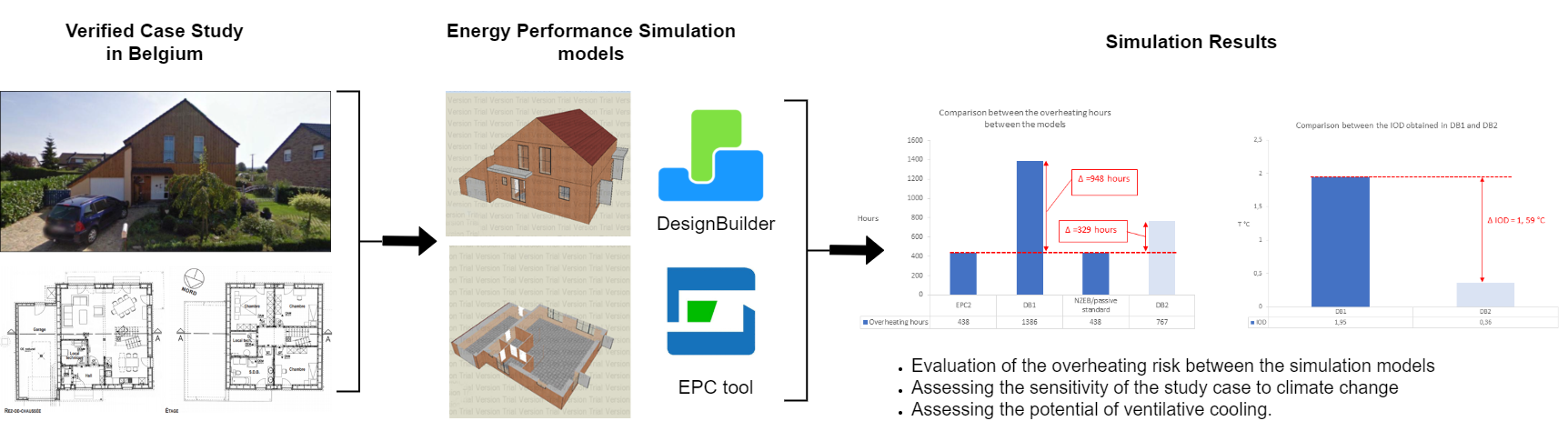 Graphical Abstract_S170333_Abdulrahman FANI_2020.png
Détails
| Titre : | Evaluation of the overheating risk and the potential of ventilative cooling : A case study in Belgium |
| Titre traduit : | [fr] Évaluation du risque de surchauffe et du potentiel de refroidissement ventilatoire: Une cas d’étude en Belgique |
| Auteur : | Fani, Abdul Rahman
|
| Date de soutenance : | 25-jui-2020/26-jui-2020 |
| Promoteur(s) : | Attia, Shady
|
| Membre(s) du jury : | Hauglustaine, Jean-Marie
Reiter, Sigrid
Rahif, Ramin
|
| Langue : | Anglais |
| Nombre de pages : | 142 |
| Mots-clés : | [en] Overheating Performance indicators Energy intensity European comfort models Simulations Residential buildings |
| Discipline(s) : | Ingénierie, informatique & technologie > Architecture |
| Public cible : | Chercheurs Professionnels du domaine Etudiants |
| Institution(s) : | Université de Liège, Liège, Belgique |
| Diplôme : | Master en ingénieur civil architecte, à finalité spécialisée en ingénierie architecturale et urbaine |
| Faculté : | Mémoires de la Faculté des Sciences appliquées |
Résumé
[en] Since buildings are responsible for approximately 40% of the EU energy consumption, the building sector is considered as the key element of European energy policies. From these policies comes the European Energy Performance of Building Directive (EPBD) that sets a clear direction for the full decarbonization of the European building stock by 2050. Within the Belgian context, the application of the EPBD is translated into Energy Performance Certificates (EPC) that are based on energy simulation softwares.
However, with the current direction of the European building sector that sets goals for achieving high-efficiency buildings, and with the constant climate change, an overheating risk is in question. This overheating risk has never been assessed in the EPC certification tool; therefore, this study aims to evaluate this overheating risk within the EPC tool of the Walloon Region, by using a verified dynamic simulation software “DesignBuilder.”
The objective of the study consists of establishing an energy simulation model of a verified case study within the Walloon Region and assessing its overheating risk compared to the DesignBuilder software, where the obtained results confirm a 216% difference in the overheated hours. As an additional contribution of the study, long-term discomfort indicators are applied to the simulation results to quantify the sensitivity of this overheating risk regarding climate change, where the obtained results confirm a minimum of 44% chance to resist climate change. Finally, the contribution of ventilative cooling is assessed within the simulation model, proving an 82% potential as a mitigation strategy.
The results of the proposed study emphasize the need to improve the current legislative framework of the Walloon Region by adopting the set of long-term thermal discomfort indicators that allow the classification of the building regarding future projections, and the necessity of adapting dynamic calculations instead of static based estimation.
Fichier(s)
Document(s)

 S170333_Abdulrahman Fani_2020_Evaluation of the overheating risk and the potential of ventilative coolin A case study in Belgium.pdf
Description: -
Taille: 6.33 MB
Format: Adobe PDF
Annexe(s)
Graphical Abstract_S170333_Abdulrahman FANI_2020.png
Description: -
Taille: 1.45 MB
Format: image/png
S170333_Abdulrahman Fani_2020_Summary_Evaluation of the overheating risk and the potential of ventilative coolin A case study in Belgium.pdf
Description: -
Taille: 89.59 kB
Format: Adobe PDF

Citer ce mémoire
L'Université de Liège ne garantit pas la qualité scientifique de ces travaux d'étudiants ni l'exactitude de l'ensemble des informations qu'ils contiennent.
