

 Master Thesis Online


Master thesis : Electrical impedance tomography for external wound monitoring : measurements, signal processing and image reconstruction

Mendolia, Loris 
Promoteur(s) :
Redouté, Jean-Michel
Date de soutenance : 5-sep-2022/6-sep-2022 • URL permanente : http://hdl.handle.net/2268.2/15567
 Tous les fichiers (archive ZIP)
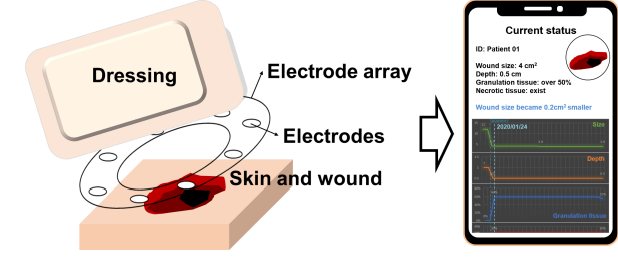 Vitapatch_concept.png
 PCB.jpg
 Current_sim.png
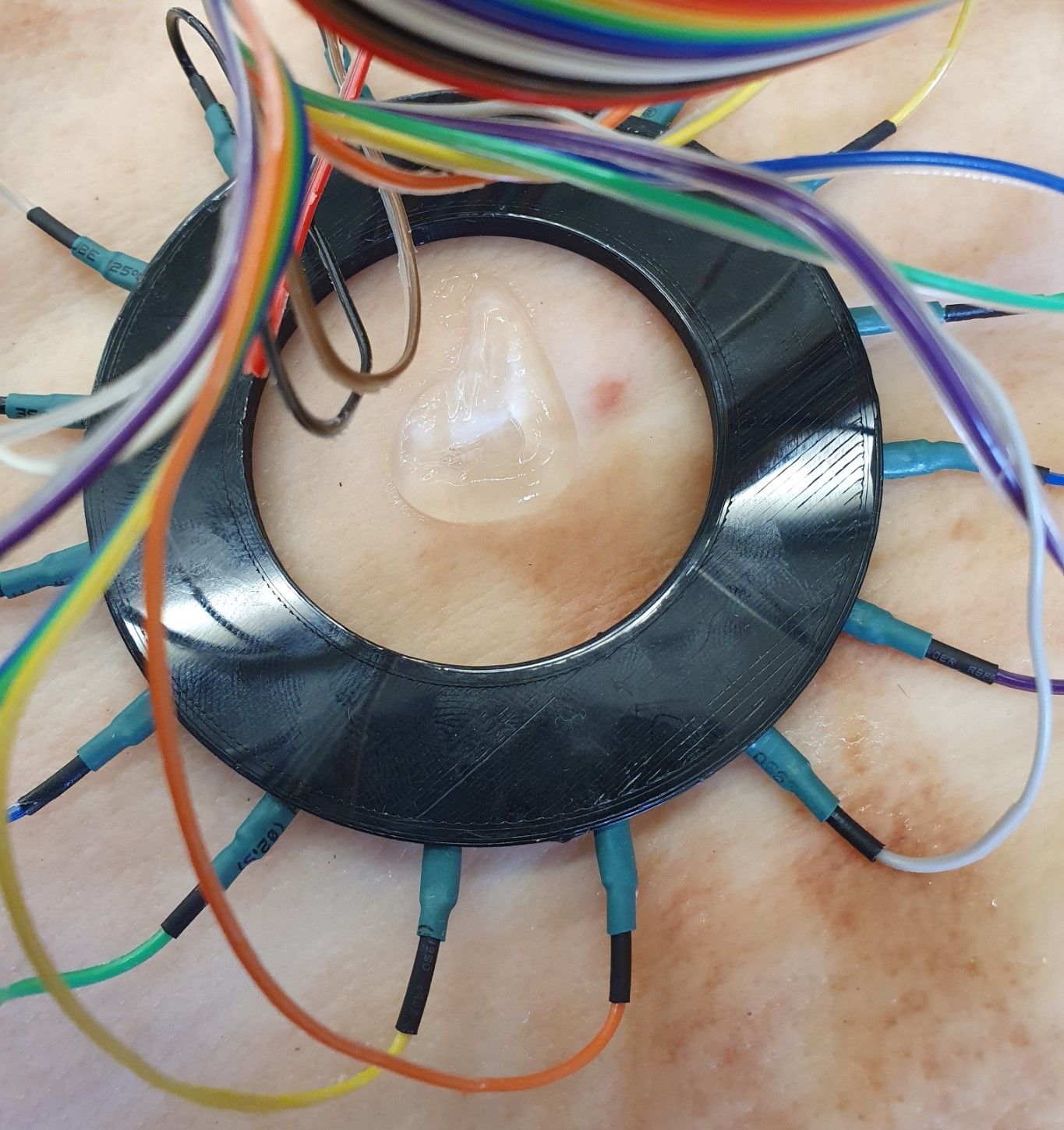 Experimental_setup_pork_skin.jpg
Détails
| Titre : | Master thesis : Electrical impedance tomography for external wound monitoring : measurements, signal processing and image reconstruction |
| Titre traduit : | [fr] Tomographie par impédance électrique pour le suivi de plaies externes : mesures, traitement de signal et reconstruction d'image |
| Auteur : | Mendolia, Loris
|
| Date de soutenance : | 5-sep-2022/6-sep-2022 |
| Promoteur(s) : | Redouté, Jean-Michel
|
| Membre(s) du jury : | Marquet, Lara
Phillips, Christophe
|
| Langue : | Anglais |
| Nombre de pages : | 140 |
| Mots-clés : | [en] Wound monitoring [en] Skin impedance measurements [en] Electrical impedance tomography [en] Impedance spectrum signal processing |
| Discipline(s) : | Ingénierie, informatique & technologie > Ingénierie électrique & électronique Sciences de la santé humaine > Médecine de laboratoire & technologie médicale |
| Centre(s) de recherche : | Laboratoire Microsys de l'Institut Montéfiore |
| Intitulé du projet de recherche : | Projet Vitapatch |
| Public cible : | Chercheurs Professionnels du domaine Etudiants |
| Institution(s) : | Université de Liège, Liège, Belgique |
| Diplôme : | Master en ingénieur civil biomédical, à finalité spécialisée |
| Faculté : | Mémoires de la Faculté des Sciences appliquées |
Résumé
[en] Assessing the state of chronic open wounds and monitoring their healing in the long term is an important but delicate task in the medical world. Manipulating and perturbing traumatized tissues too often hinders the healing process and prolongs the burden for the patient and the medical system. Conversely, ignoring complications such as bacterial infection or necrotic tissue for too long can lead to dramatic consequences, from the need for amputation to septic shock and death.
Nowadays, chronic wound monitoring is still a matter of frequent visual inspections, which requires medical expertise and intrusions into the daily lives of patients.
The Vitapatch research project, for which this thesis has been carried out, aims at solving this issue by creating easily deployable smart sensor patches capable of long-term continuous monitoring of a chronic wound in a non-invasive manner.
This thesis explores the use of bioimpedance spectroscopy to assess the state of human skin, and electrical impedance tomography as an image reconstruction tool to provide a non-intrusive visual assessment of wound healing.
After briefly reminding the concepts of electrical impedance and conduction of electricity, the physiological and electrical properties of human skin and tissues are presented, and the impacts of a wound on these properties are discussed. Then, the methodology for bioimpedance measurements is explained, with specific care toward long-term medical applications. Following, the prototype bioimpedance spectroscopy circuit created by Microsys is analyzed and simulated. After that, the required signal processing steps to make this circuit work are presented, and the journey towards experimental validation of the processing routine is described. Proceeding, electrical impedance tomography is introduced, different algorithms are assessed through simulations and a preliminary application is presented. Adaptations of the EIT problem to wound imaging are performed, and image reconstruction on a finite-element model of wounded skin is simulated. Finally, an experimental setup for wound assessment on phantom skin is presented. Repeated hardware delays and unfinished or faulty components have prevented the completion of real-life experiments, but simulations show promising prospects for a nontraditional approach to impedance spectroscopy and signal processing, as well as for skin modeling and applications of electrical impedance tomography to non-invasive wound imaging.
Fichier(s)
Document(s)

 MENDOLIA_Loris_Master_Thesis.pdf
Description: -
Taille: 15.8 MB
Format: Adobe PDF
Annexe(s)

 Current_sim.png
Description: Current injection simulation for skin EIT
Taille: 62.92 kB
Format: image/png
Experimental_setup_pork_skin.jpg
Description: Experimental setup for wound image reconstruction using pork skin
Taille: 405.66 kB
Format: JPEG
MENDOLIA_Loris_Master_Thesis_Summary.pdf
Description: Résumé du travail
Taille: 70.49 kB
Format: Adobe PDF
Regressed_spectrum.pdf
Description: Least-squares boosting for PRBS spectroscopy noise removal
Taille: 99.78 kB
Format: Adobe PDF
Tank_image.pdf
Description: Electrical impedance tomography in a water tank
Taille: 1.17 MB
Format: Adobe PDF
Skin_FEM.pdf
Description: FEM model of human skin layers with surface EIT electrodes
Taille: 93.9 kB
Format: Adobe PDF
Wound_image_sim.pdf
Description: Simulated image reconstruction of a wound on the skin FEM model
Taille: 396.92 kB
Format: Adobe PDF

Citer ce mémoire
L'Université de Liège ne garantit pas la qualité scientifique de ces travaux d'étudiants ni l'exactitude de l'ensemble des informations qu'ils contiennent.
